
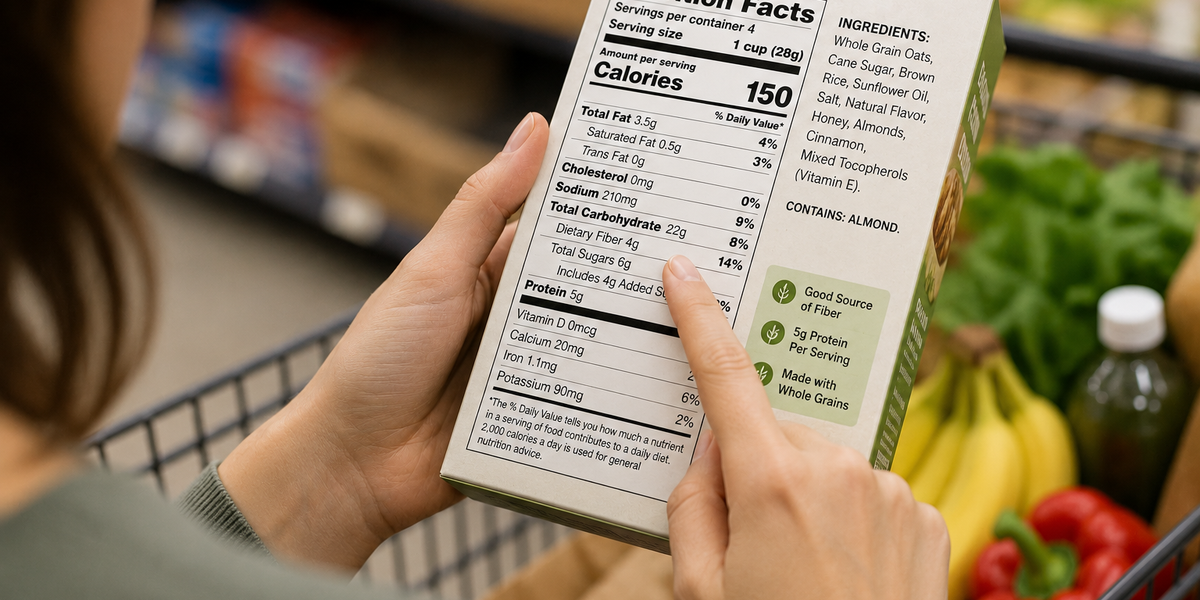
How to Read a Nutrition Label Like You Mean It
Nutrition labels are everywhere, yet many of us barely look at them.
We might glance at the calories, notice a “high in protein” claim, or see the words “low fat” on the front of the package before tossing it into our shopping basket. But a nutrition label tells a much bigger story than a few numbers on the front of the box.
Learning how to read it properly doesn’t mean obsessing over every gram or avoiding your favorite foods. It simply helps you make more informed choices and better understand what you’re actually eating. Once you know what to look for, those small labels become one of the most useful tools in the supermarket.
Start with the serving size
One of the most common mistakes people make is assuming the nutrition information applies to the entire package. In reality, the values listed almost always refer to a single serving, and many packaged foods contain two, three, or even more servings.
That means a bottle of juice, a bag of chips, or a frozen meal may contain significantly more calories, sugar, fat, or sodium than you first realize if you eat the entire package.
Checking the serving size before looking at anything else gives the rest of the nutrition information context. Without it, the numbers can easily be misleading.
Don’t judge food by calories alone
Calories are important because they measure how much energy a food provides, but they don’t tell you everything about its nutritional value.
Two foods can contain the same number of calories while offering completely different benefits. For example, a handful of nuts and a sugary snack bar may provide similar amounts of energy, but nuts also contain healthy fats, fiber, vitamins, and minerals that help keep you feeling satisfied for longer.
Rather than focusing only on calories, try looking at the overall nutritional profile. Ask yourself whether the food is likely to nourish your body, not simply fill you up for a short period of time.
Pay attention to protein and fiber
If there are two numbers worth checking regularly, they’re protein and fiber.
Protein plays an important role in building and maintaining muscle, supporting many functions throughout the body, and helping you feel full after meals. Fiber is equally important because it supports digestive health and can also increase satiety, making it easier to stay satisfied between meals.
Foods that naturally contain more protein and fiber are often more filling than highly processed foods that are low in both. Including these nutrients regularly can make balanced eating much easier without feeling like you’re constantly hungry.
Keep an eye on added sugars and sodium
Many packaged foods contain more added sugar or sodium than people realize. Breakfast cereals, flavored yogurts, sauces, ready-made soups, salad dressings, and even products marketed as “healthy” can sometimes contain surprisingly high amounts.
Reading the nutrition label allows you to compare similar products and choose the option that better fits your needs.
It’s also helpful to look at the ingredient list. Ingredients are listed in descending order by weight, so if added sugar appears near the top of the list, the product likely contains a significant amount of it.
The goal isn’t to eliminate sugar or salt entirely. It’s simply to understand where they’re coming from and make informed choices.
Don’t let the front of the package fool you
Food packaging is designed to attract attention.
Words like “natural,” “multigrain,” “high protein,” “low fat,” “organic,” or “made with real fruit” often make products sound healthier than they actually are.
That’s why it’s important to look beyond the marketing and turn the package over.
A product can advertise one positive feature while still containing large amounts of added sugar, saturated fat, or sodium. The nutrition label and ingredient list almost always provide a much more accurate picture than the claims printed on the front of the package.
Remember that your overall diet matters most
It’s easy to label foods as “good” or “bad,” but nutrition is rarely that simple.
No single meal determines your health, just as one salad or one slice of cake doesn’t define your eating habits. Nutrition labels aren’t there to make you feel guilty—they’re there to help you make informed decisions.
The healthiest approach is to focus on your overall eating pattern rather than obsessing over individual foods. A balanced diet can include both nutritious everyday meals and occasional treats without either one defining your health.
Small choices add up over time
Reading a nutrition label takes only a few extra seconds, but those small moments of awareness can lead to better decisions over time.
You may start choosing the cereal with more fiber, the yogurt with less added sugar, or the soup that’s lower in sodium. None of these choices will transform your health overnight, but together they create healthier habits that become part of your everyday routine.
The people who make the healthiest choices aren’t usually the ones who memorize every nutrition fact or follow strict rules. They’re the ones who understand the basics, stay curious, and remember that good nutrition is built through consistent habits—not perfection.