The Difference Between Discipline and Motivation
People often talk about motivation as if it’s the secret to success.
We’re told to find our passion, stay inspired, and wait until we feel ready to take action. When motivation is high, starting a new habit or working toward a goal feels almost effortless.
The problem is that motivation doesn’t last.
Some days you’ll wake up excited to work out, tackle your to-do list, or start a new project. Other days, even simple tasks will feel difficult. That’s completely normal. Motivation naturally comes and goes, which is why relying on it alone often leads to inconsistency.
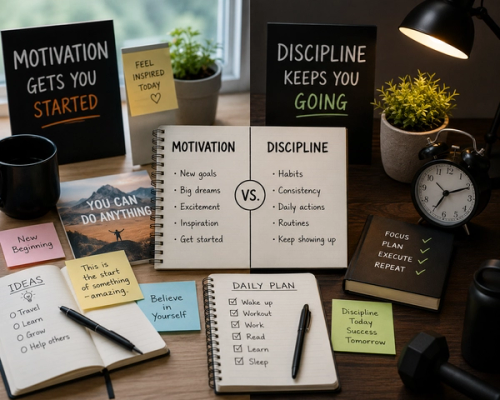
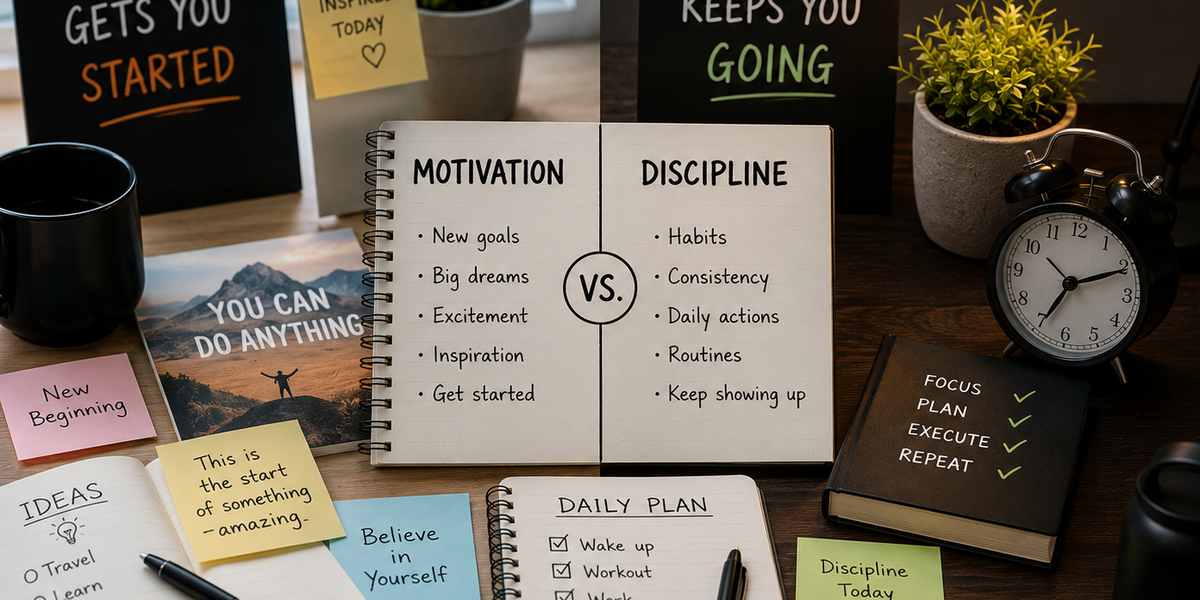
Discipline, on the other hand, is what keeps you moving when motivation disappears.
Motivation gets you started
Think back to the last time you felt inspired to make a change.
Maybe you watched a documentary about health, listened to an inspiring podcast, or saw someone achieve something you admired. Suddenly, everything felt possible.
That initial burst of motivation is powerful.
It encourages us to join the gym, sign up for a course, create a budget, or finally begin working on a long-delayed goal.
There’s nothing wrong with motivation.
In fact, it’s often what gives us the courage to take the first step.
The challenge is that emotions change. A stressful week at work, poor sleep, bad weather, or a busy schedule can quickly make that excitement disappear.
If motivation is the only thing keeping you going, your progress usually disappears with it.
Discipline keeps you moving
Discipline isn’t about forcing yourself to work every minute of the day.
It’s about following through on the commitments you’ve made, even when you don’t particularly feel like it.
The person who exercises regularly isn’t necessarily more motivated than everyone else.
They’ve simply decided that movement is part of their routine.
The writer who finishes a book doesn’t always wake up full of creative energy.
They sit down and write anyway.
Discipline turns actions into habits.
Instead of asking yourself every day whether you feel motivated enough, you remove the decision altogether.
The habit becomes something you simply do.
Build systems instead of relying on willpower
One reason disciplined people appear consistent is that they’ve created systems that make good decisions easier.
They prepare their workout clothes the night before.
They schedule time for focused work instead of hoping they’ll find the motivation later.
They keep healthy food within easy reach and remove unnecessary distractions from their environment.
These small systems reduce the number of decisions they need to make.
When your environment supports your goals, discipline requires much less effort.
You’re no longer depending on a perfect mood to do the right thing.
Consistency matters more than intensity
Many people believe success comes from working harder than everyone else.
More often, it comes from showing up consistently.
A person who reads ten pages every day will probably finish more books over the course of a year than someone who reads an entire book in one weekend and then doesn’t open another for months.
The same is true for exercise, learning new skills, saving money, or building a business.
Small actions repeated regularly usually produce better long-term results than occasional bursts of intense effort.
Discipline isn’t about doing everything.
It’s about doing enough, often enough.
Discipline doesn’t mean never taking a break
Sometimes discipline is misunderstood as pushing through exhaustion at all costs.
In reality, knowing when to rest is part of staying consistent.
No one performs at their best every single day.
There will be times when you’re sick, emotionally drained, or simply need a break.
Rest isn’t the opposite of discipline.
It’s what makes discipline sustainable.
The goal isn’t to avoid every interruption.
It’s to return to your habits once you’re ready instead of assuming you’ve failed.
The people you admire aren’t motivated every day
It’s easy to look at successful people and assume they must wake up feeling inspired every morning.
The reality is usually much less glamorous.
Athletes train when they don’t feel like training.
Writers write when inspiration is missing.
Business owners keep solving problems even after difficult setbacks.
What separates them isn’t constant motivation.
It’s the willingness to keep showing up, even when the excitement has faded.
Success is built on the days you don’t feel like it
Anyone can work toward a goal when everything is going well.
The real difference appears on the ordinary days.
The rainy morning when you’d rather stay in bed.
The evening when you’re tired after work.
The afternoon when progress feels slow and nobody is watching.
Those are the moments when discipline quietly takes over.
Motivation may help you begin the journey.
But discipline is what carries you the rest of the way.
And over time, those ordinary moments of choosing to keep going become the foundation for extraordinary results.