The Two-Minute Rule That Solves Procrastination
Procrastination rarely begins with a big decision. More often, it starts with a small thought: “I’ll do it later.” “I’ll start after lunch.” “I’ll wait until I have more energy.” Before you know it, hours—or even days—have passed, and the task you meant to do still hasn’t been started. One surprisingly effective way to break this cycle is something known as the Two-Minute Rule. It’s a simple idea that removes one of the biggest obstacles to getting things done: the pressure of getting started. While it won’t magically eliminate procrastination forever, it can make beginning a task feel much less intimidating.
Why starting is the hardest part
Most people don’t procrastinate because they’re lazy. Psychologists suggest we often delay tasks because they feel uncomfortable, overwhelming, boring, or emotionally demanding. Our brains naturally avoid situations that create discomfort, even if avoiding them ultimately creates more stress. Interestingly, once we’ve started working, that resistance often begins to fade. The task usually turns out to be much easier than we imagined, which is why the biggest challenge isn’t finishing the work—it’s taking the first step.
What is the Two-Minute Rule?
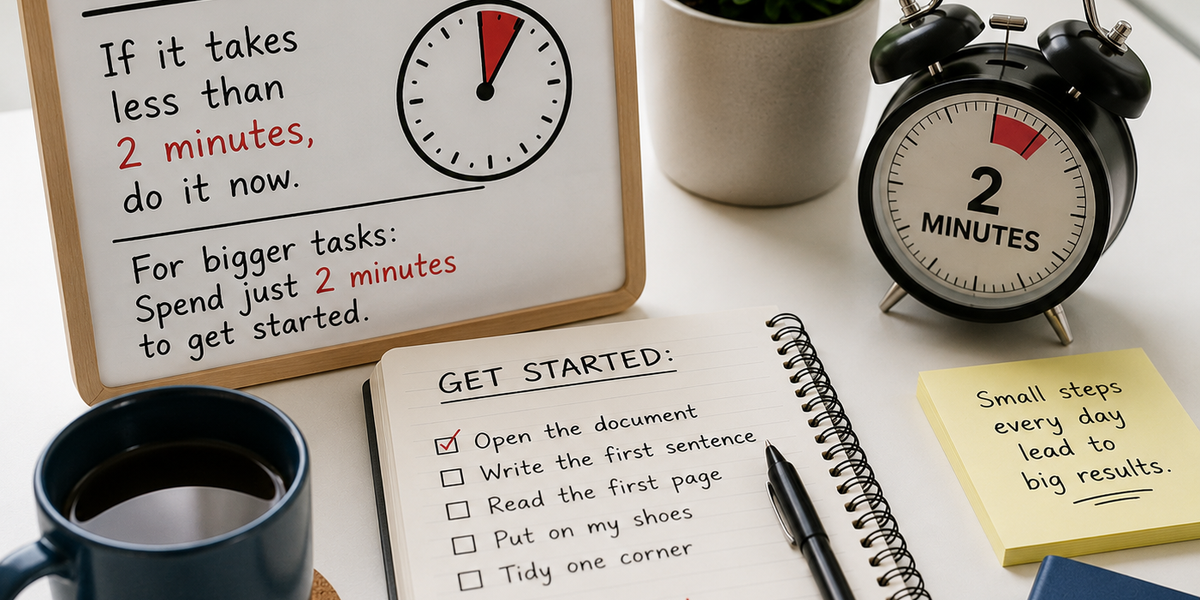
The Two-Minute Rule is based on a very simple principle. If a task takes less than two minutes to complete, do it immediately. Reply to the email, wash the coffee mug, put away your clothes, book the appointment, or take out the rubbish instead of leaving it for later. These small actions stop tiny tasks from piling up into a long to-do list that eventually feels overwhelming.
The rule is just as useful for larger projects. Instead of telling yourself that you have to finish an entire report or complete a full workout, commit to spending just two minutes getting started. Open the document and write the first sentence. Read the first page of the book. Put on your running shoes. Organize one drawer. The objective isn’t to finish everything in two minutes—it’s simply to make starting feel so easy that your brain stops resisting it.
Small actions create momentum
One of the reasons the Two-Minute Rule is so effective is that action naturally creates momentum. Once you’ve started writing, it’s usually easier to keep going. Once you’re already dressed for a workout, skipping it feels much less appealing. Once you’ve cleaned one corner of the kitchen, finishing the rest often seems much more manageable.
Psychologists sometimes refer to this as overcoming the “activation energy” of a task. The beginning requires the greatest mental effort, while continuing often feels surprisingly natural. By reducing the size of that first step, you lower the psychological barrier that normally leads to procrastination.
It helps build lasting habits
The Two-Minute Rule isn’t only a productivity strategy—it’s also one of the simplest ways to build habits that last. If you want to read more, don’t commit to finishing a chapter every night. Start by reading for two minutes. If you want to meditate, begin with two minutes instead of twenty. If your goal is to exercise consistently, focus on putting on your trainers and moving for just a couple of minutes.
At first, this approach may seem too easy to make a difference. However, consistency is almost always more important than intensity. Repeating a small habit every day creates a routine that’s much easier to maintain than ambitious goals that quickly become overwhelming. Once the habit feels automatic, increasing the time or effort becomes much easier.
Don’t underestimate small progress
Many people dismiss small actions because they don’t seem significant enough to matter. They wonder what difference reading one page, writing one paragraph, or taking a short walk could possibly make.
The answer is that small actions are repeatable. Reading a few pages every day eventually becomes several books a year. Saving a modest amount each month gradually builds financial security. Ten or fifteen minutes of movement each day adds up to dozens of hours of physical activity over the course of a year.
Progress rarely comes from one extraordinary effort. Much more often, it’s the result of ordinary actions repeated consistently over a long period of time.
The goal isn’t two minutes
Here’s the interesting part: the Two-Minute Rule isn’t really about spending only two minutes on a task. It’s about making the first step so easy that you stop postponing it.
More often than not, those two minutes naturally become ten. Ten become thirty. Before you know it, you’ve made meaningful progress on something you’ve been avoiding for days or even weeks. And even if you genuinely stop after two minutes, you’ve still moved closer to your goal than if you’d delayed it until tomorrow.
Make starting your new habit
The biggest difference between people who procrastinate less and those who struggle with it isn’t necessarily motivation. It’s that they’ve learned how to make starting easier.
The Two-Minute Rule removes the pressure to do everything perfectly or all at once. Instead of focusing on finishing an entire project, it encourages you to focus only on beginning. That small shift in mindset can completely change the way you approach difficult tasks.
Because in the end, the hardest part of almost anything isn’t completing it. More often than not, it’s simply convincing yourself to take the very first step.