How to Write a Resume That Actually Gets Read
Your resume has one job.
It isn’t to tell your entire career story or list everything you’ve ever done. Its purpose is much simpler: to convince someone that you’re worth interviewing.
The challenge is that recruiters and hiring managers often spend only a short time scanning each resume before deciding whether to continue reading. That means clarity matters more than length, and relevant experience matters more than trying to include every job you’ve ever had.
A strong resume doesn’t just describe your work history—it quickly shows why you’re a good fit for the role.
Tailor your resume for each application
One of the biggest mistakes job seekers make is sending the same resume to every employer.
Different companies prioritize different skills, even for similar roles.
Before applying, carefully read the job description and identify the qualifications, experience, and keywords that appear most often.
Then adjust your resume to reflect the parts of your experience that are most relevant.
That doesn’t mean exaggerating or changing the truth. It means highlighting the achievements and responsibilities that best match the position you’re applying for.
A tailored resume shows employers that you’ve taken the time to understand what they’re looking for.
Focus on achievements, not just responsibilities
Many resumes read like job descriptions.
They list tasks such as:
- Managed projects.
- Responded to customer inquiries.
- Prepared reports.
- Coordinated meetings.
While these explain what you did, they don’t show how well you did it.
Whenever possible, describe your impact instead.
For example:
- Led a cross-functional project that launched two weeks ahead of schedule.
- Reduced reporting time by 30% through process improvements.
- Managed a portfolio of more than 50 clients while maintaining high customer satisfaction.
- Organized an event attended by over 500 participants.
Specific accomplishments help employers understand the value you’ve brought to previous roles.
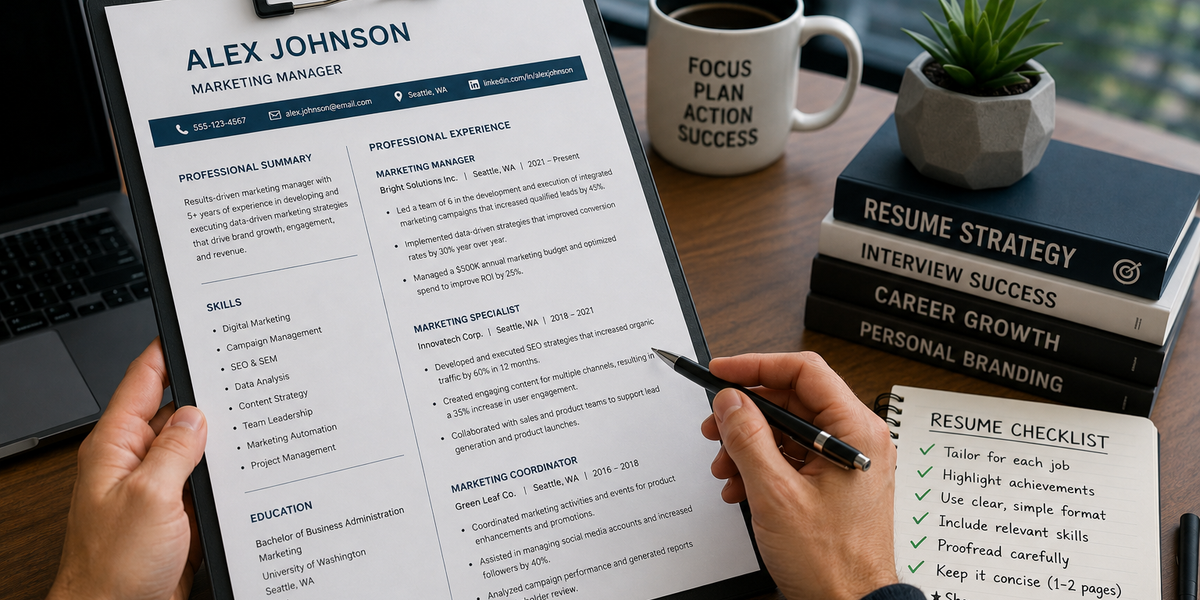
Keep the design clean and easy to scan
A resume doesn’t need elaborate graphics or complicated layouts to stand out.
In fact, simple formatting is often more effective.
Use clear section headings, consistent spacing, and an easy-to-read font.
Keep enough white space so the document doesn’t feel crowded.
Recruiters should be able to quickly find:
- Your contact information
- Professional summary
- Work experience
- Education
- Relevant skills
If they have to search for important information, they’re more likely to move on to the next application.
A clean layout makes your experience easier to understand.
Include skills that are relevant
A long list of generic skills rarely makes a strong impression.
Instead of adding every software program or workplace buzzword you can think of, focus on the skills most relevant to the role.
These may include technical expertise, industry knowledge, project management, languages, communication, leadership, or analytical skills.
Whenever possible, reinforce those skills with examples from your work experience rather than listing them on their own.
It’s one thing to say you have leadership skills.
It’s much stronger to describe how you led a team or managed a successful project.
Proofread more than once
Even small mistakes can leave the impression that you rushed your application.
Before sending your resume:
- Check for spelling and grammar errors.
- Make sure dates are consistent.
- Verify job titles and company names.
- Confirm that formatting is uniform throughout the document.
- Test that any links to your professional profiles or portfolio work correctly.
It also helps to ask someone else to review your resume.
Fresh eyes often catch mistakes you’ve overlooked after reading the same document multiple times.
Remember what employers are really looking for
Recruiters aren’t searching for a perfect candidate.
They’re looking for someone who appears capable of solving problems, contributing to the team, and growing in the role.
Your resume should make that easy to see.
Instead of trying to impress employers with long lists of responsibilities or complicated language, focus on communicating your experience clearly and confidently.
A concise, well-organized resume is far more effective than one filled with unnecessary detail.
The goal isn’t to tell employers everything you’ve ever accomplished.
It’s to give them a clear reason to invite you to the next conversation.
A resume that gets read isn’t necessarily the most creative one.
It’s the one that quickly answers the question every hiring manager is asking: Why should we meet this person?